GRI 2-9, 2-10, 2-11, 2-12, 2-13, 2-14, 2-15, 2-16, 2-17, 2-18,
2-23, 2-24, 2-25, 2-26, 3-3, 205-2
Conducted by CEPEL’s higher bodies – the General Assembly, the
Deliberative Council and the Executive Board, supported and
supervised by the Fiscal Council—the governance roles are
responsible for directing and monitoring the organization. The
Executive Board is responsible for the administration of the
Center, ensuring the execution of the decisions of the
Deliberative Council and the General Assembly of Founding
Members. They are also responsible for proposing plans and
policies, as well as submitting the Annual Budget Plan,
Financial Report, Balance Sheet, and contracts of significant
value for approval by these bodies, in accordance with the
Purchasing Policy and approval limits.
By institutionalizing the Compliance Program, based on
Eletrobras’ guidelines and orientation, Cepel observes good
governance and administration practices, in addition to
respecting the specificities of its legal nature. The program
establishes the creation of mechanisms to detect and correct
misconduct and illegal acts, as well as the adoption of
preventive measures, capable of preventing such deviations
from occurring, following the five dimensions listed below:
Led by the top organs of Cepel – General Assembly,
Deliberative Council, and Executive Board, supported and
overseen by the Fiscal Council – governance functions are
responsible for guiding and monitoring the organization.
-
Development of a business management environment focused on
Compliance
- Periodic risk assessment
-
Structuring and implementation of policies, standards, and
procedures
-
Internal promotion of communication and training activities
-
Continuous monitoring of the program, as well as remediation
measures and application of penalties
As a result, several formal documents of Cepel began to provide
for corporate integrity criteria so that the Compliance Program is
effectively inserted in the activities most exposed to the risk of
fraud and corruption, including the Code of Ethical Conduct and
Integrity, Anti-Corruption Policy, Consequences Policy and
Conflict of Interest Management Policy, among others.
In this context, CEPEL’s Internal Audit, Risk Management and
Compliance area acts as an incentive for the dissemination of the
compliance culture, based on the evaluation and treatment of
issues related to document management, LGPD, conflicts of
interest, fraud and corruption, Due Diligence and the
implementation and coordination of a robust integrity program.
The main policies of Cepel are publicly available and can be
accessed at the
website.
Organizational Structure of Cepel
Click to zoom
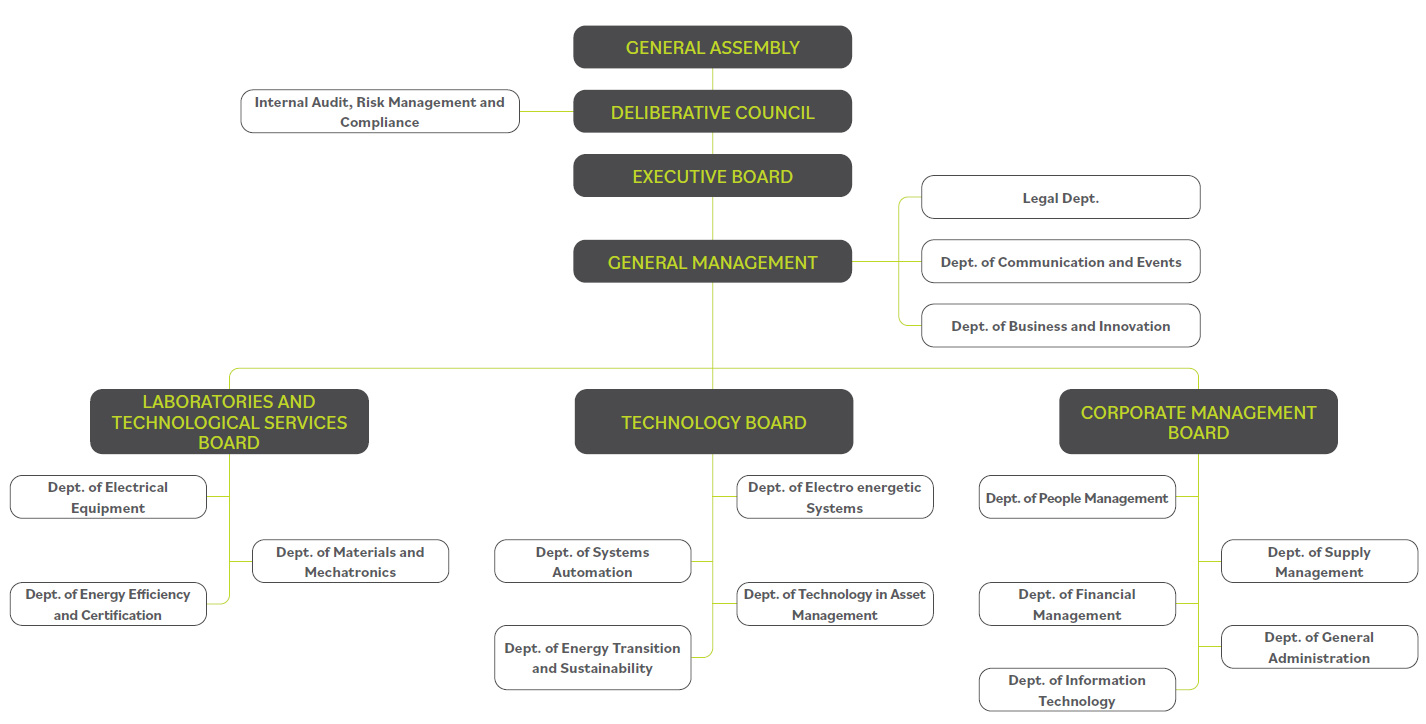
In accordance with Article 15 of its Bylaws, Cepel has a
Deliberative Council; it is administered by an Executive Board
and supervised by a Fiscal Council. Its Founding Associates
(Eletrobras, Furnas, Chesf, Eletronorte and CGT Eletrosul) meet
in the General Assembly for the necessary deliberations.
According to the current internal regulations, the members of
the governance bodies must be citizens of excellent reputation,
have notorious knowledge compatible with the position for which
they were appointed, have an academic background compatible with
the position and have proven professional experience in the
company’s area of operation.

The General Assembly is the highest governance body of
the Centre and is formed by the representatives of the
Founding Associates. The members appointed to compose the
General Assembly also compose the Deliberative Council,
alongside representatives of the Special Associates.
The appointment and selection of the members at the General
Assembly are carried out by Eletrobras, which prioritizes the
diversity of profiles (gender, age, ethnicity and culture) in
the composition of its management bodies, in order to achieve
the complementarity of experiences, qualifications and
professional specializations, so that the decision-making
process happens with greater quality and safety.
Currently, the General Assembly is composed of five full
members and five alternate members, eight men and two women.
The members of the General Assembly are executives external to
Cepel, who are part of the framework of the Founding
Associated companies. However, the directors of the Center
attend the meetings as guests. The work of the General
Assembly is presided over by the direct representative of
Eletrobras or a substitute appointed by him, with the
participation of a secretary chosen from among those present,
responsible for drafting the minutes of the meeting.
It is the exclusive responsibility of the General Assembly to
elect and dismiss the members of the Executive Board, amend
the Bylaws and approve Cepel’s accounts. It also has the
exclusive competence to deliberate on the admission and
exclusion of Associates, to approve the Internal Regulations
of the Association and the annual contributions of the
Associates.

The Deliberative Council is composed of representatives
of the Founding and Special Members, respecting the limit of
20 members, distributed in accordance with the following rule:
-
Six board members appointed by Eletrobras, with one vote
each;
- General Director of Cepel, with one vote;
-
Four board members appointed, respectively, by the
Associates Furnas, Chesf, CGT Eletrosul and Eletronorte,
with one vote each;
-
An effective employee of Cepel, in activity, with the right
to one vote, chosen through an inquiry process, by personal,
direct and secret choice of the effective employees of the
Center, and
-
Up to eight directors appointed by the Special Associates,
represented by class, as follows: Class 1: up to four
representatives, with the right to one vote each; Class 2:
up to three representatives, with the right to one vote
each; Class 3: up to one representative, entitled to one
vote.
In the current term, the Deliberative Council is composed of
19 full members, 15 men and 4 women. In addition, the body has
18 alternate members, 13 men and 5 women. Before being
appointed, nominees fill out a form describing their
professional experiences and technical skills, which must be
relevant and adherent to the position of Cepel’s advisor. The
term of unified management of the full and alternate members
of the Deliberative Council is two years, being allowed, at
most, three consecutive reappointments.

CEPEL’s Executive Board is composed of a General
Director, a Director of Corporate Management, a Director of
Laboratories and Technological Services and a Director of
Technology. In accordance with article 38, paragraph 1, of the
Center’s Bylaws, the Chief Executive Officer and the other
Officers are chosen from among the names indicated by
Eletrobras and approved by the General Meeting. The term of
unified management of the Executive Board is two years, with
no more than three consecutive reappointments.

In turn, the Fiscal Council of Cepel, a management
support body, is composed of three directors, one appointed by
the Founding Associate Eletrobras, one indicated by the other
Founding Associates (Furnas, Chesf, CGT Eletrosul and
Eletronorte) and one indicated by the Special Associates. The
president of the Fiscal Council and his substitute are chosen
from among the directors appointed by Eletrobras and other
Founding Associates and the term of action of the members is
also two years, with permission for, at most, three
consecutive reappointments.
To fulfill its statutory duties and act in an integrated and
efficient manner, the Executive Board meets once a week, and
extraordinary meetings may occur whenever necessary. The
resolutions are submitted to the collegiate, by the respective
Executive Officer, by completing the form Report to the Board
of Executive Officers—RDE, including the objective,
justification, and proposal for a decision. The General
Assembly, as a collegiate body of deliberation, consultation,
and manifestation of the Founding Associates, has ordinary
meetings held twice a year, or whenever necessary.
The main attributions of the Deliberative Council are: to
ensure that the strategic guidelines are effectively
implemented by the Executive Board and to discuss, approve and
monitor decisions involving good corporate governance
practices, relationship with stakeholders, people management
policy and code of conduct of agents, as well as to implement
risk management policy, accompanying its implementation.
Currently, the Council meets as often as necessary, with a
minimum of four meetings per year.
With the responsibility of supervising the acts of management,
especially with regard to the financial and accounting
management of Cepel, the Fiscal Council is a statutory body of
support and meets, ordinarily, once a quarter, or,
extraordinarily, when convened by its president, by the
majority of the members, by the president of the Deliberative
Council or by the Executive Board.
The Bylaws of Cepel are available at
website.
Every six months, the Ombudsman presents to the Executive Board
and, subsequently, to the Deliberative and Fiscal Councils, the
Ombudsman Report where all manifestations (compliments,
complaints, suggestions, and information requests) received by
the Ombudsman System (SOU) are dealt with, ensuring a response
to all interested parties, as well as the treatment given to
each one of the manifestations.
Manifestations received and registered in the SOU in 2022:
- Total of 15 manifestations, being 4 complaints, 10 requests and
1 compliment;
Complaints received in the Eletrobras Complaints Channel in
2022:
- Total of 7 complaints, 6 of which were considered normal
flow and 1 high hierarchy. All complaints were properly
handled and finalized in the system.
The complaints were classified as follows: Standards/
Regulations/Contracts/Legislation (3 complaints); Violation
of the Integrity Program, involving fraud and corruption (no
complaints); Ethical Infraction (1 complaint). Furthermore,
three complaints received were classified as out of scope.
After finalizing the complaints in the system, the
conclusion was: 1 complaint that was well founded, 2
complaints that were not substantiated, 1 that was not
conclusive, 2 that were out of scope and that there were 1
complaint of insufficient data. It is worth mentioning that
the complaint finalized as “valid” was returned to Cepel for
inclusion in the SOU system, because after treating the
complaint by Eletrobras and Deloitte, Eletrobras classified
it as out of scope.
Participation in associations
GRI 2-28
Currently, Cepel has a seat in the governance bodies of the
following associations:
-
Memory of Electricity – a seat on the Board
of Directors and the Fiscal Council
-
ABIPTI (Brazilian Association of Technological Research and
Innovation Institutions)
– a seat on the Fiscal Council
-
Eletros Saúde Foundation - a seat on the
Fiscal Council and the Board of Directors
-
Eletros Previdência Foundation - a seat on
the Deliberative Council;
-
CIBIOGAS (International Center for Renewable Energy)
– a seat on the Board of Directors and Fiscal Council + D13
-
CIGRE-BRASIL (International Committee for Producing and
Transmitting Electricity)
- a seat on the Board of Directors
-
FGV Energia - a seat on the Advisory Board
-
Alberto Luiz Coimbra Institute of Graduate Studies and
Engineering Research, unit of the Federal University of Rio
de Janeiro - Business incubator COPPE/UFRJ
- a seat on the Board of Directors
-
BRACIER (Brazilian Committee of the Regional Energy
Integration Commission)
– a seat in the Executive Department
-
ISI-ER (Senai Institute of Innovation - Renewable Energies)
- a seat on the Advisory Board
Aside from that, the company participates in projects and
commissions in the following associations:
-
ABNT (Brazilian Association of Technical
Standards)
-
ABENDI (Brazilian Association of
Non-Destructive Testing and Inspection)
-
ABM (Brazilian Association of Metallurgy and
Materials)
-
ABRACO (Brazilian Association of Corrosion)
- CIGRE-BRASIL
-
CIEESE (Integrated Energy Efficiency
Committee of Eletrobras Companies)
-
Technical Advisory Committee of the Cooperation Program
“Transformative Energy Efficiency Investments in Industry,”
coordinated by the DeutscheGesellschaft für Internationale
Zusammenarbeit
- GIZ GmbH
- CRQ (Regional Council of Chemistry)
-
GCCE (Coordinating Group for the Conservation
of Electricity)
-
Working Group of the Project “Efficient Commercial
Refrigerators in Brazil”, of the Ministry of Mines and
Energy
– MME
-
GT-EDIFICAÇÕES/MME (Technical Group of the
MME for Energy Efficiency in Buildings in the Country)
-
NEMA (National Electrical Manufacturers
Association)
- Eletrobras’ Environment Committee
-
Executive Committee for Sustainability Management of
Eletrobras Companies
- BRACIER.
Supplier Management
GRI-205-1, 408-1, 409-1
Cepel foresees in its activities the engagement of its suppliers
in relation to topics of interest and their evaluation in
aspects of integrity. The main forms of engagement are
awareness-raising actions, dissemination of educational videos,
distribution of booklets, frequent meetings and adoption of
integrity clauses in all contracts, in addition to the Supplier
Integrity Assessment Guide, which stipulates, among other
procedures, the completion of the Due Diligence, important tool
that reveals potential risks and conflicts of interest.
When suppliers with high or very high risk are identified, Cepel
conducts background checks, including partners, and establishes
a monitoring action plan. In 2022, 100% of suppliers exposed to
the risks of fraud and corruption were duly evaluated by Due
Diligence Integrity form, totaling 18 companies.
Cepel ended 2022 with 821 suppliers with contracts in force in
the period, including small orders, which represents an increase
of 104.2% compared to 2021 (402 suppliers). Regarding the total
amount hired through bidding, waiver, unenforceability and
additives, the total was R$ 113,248,328.15.
CRITICAL SUPPLIERS ASSESSED FOR INTEGRITY RISKS – GRI-205-1
|
NUMBER OF CRITICAL SUPPLIERS UNDER THE ASPECT OF
INTEGRITY (UN). (un)
|
18
|
|
REPORT THE TOTAL NUMBER OF CRITICAL SUPPLIERS UNDER
THE ASPECT OF INTEGRITY SUBMITTED TO CORRUPTION RISK
ASSESSMENTS, BY THE INTEGRITY AREAS (un)
|
18
|
|
PERCENTAGE OF CRITICAL SUPPLIERS UNDERGOING
CORRUPTION-RELATED RISK (INTEGRITY) ASSESSMENTS
(COMPLETED AND ONGOING) (%)
|
100
|
The monitoring processes of the Integrity Program are formalized
in Cepel’s Supplier Integrity Assessment Guide, involving the
collection and verification of information necessary for the
analysis and control of the effectiveness of the mechanisms
implemented and their continuous evolution. Among these
processes, it is important to highlight Calculation, analysis,
and monitoring of the indicators of the Integrity Program. The
suppliers that show significant risks of occurrence of cases for
child labor, forced labor or analogous to slavery are those who
have contracts that use allocated labor, currently executed by
14 suppliers.
The suppliers operate at CEPEL’s facilities in Rio de Janeiro
(Cidade Universitária) and Nova Iguaçu (Adrianópolis).
To prevent cases of child or slave labor from occurring, Cepel
has prepared a declaration that must be signed by all suppliers,
stating that it does not have in its staff employees under 18
years of age (in night, dangerous or unhealthy work) and under
16 years of age in any other type of work, except as
apprentices, from 14 years old.
The company has other procedures that help in the subject, such
as the Criticality Matrix, Supply Logistics Policy,
participation in the National Meeting of Suppliers, integrated
Portal “Supplier Space” and the Supplier Conduct Guide, in
addition to a specific contractual clause referring to the
Integrity Program (Compliance).
The documentary diligence, carried out by managers and
inspectors of the contracts in order to monitor the execution of
the relevant activities, also allows to observe and present such
measures. In 2022, there were no reported cases of child labor,
forced labor, or slave labor.